LORENZO BENEDETTI
The Narrow Gap Between Abstraction and Reality
This text was first published in Between Red and a Transparent Plane,
De Vleeshal, Middelburg / Roma Publications, Amsterdam 2014.
The tradition of seventeenth-century Dutch painting focused on one of the key issues in the reproduction of reality. Detailed documentation of the tiniest features is something that has never been studied
in such depth as in the works of Pieter Claesz and Willem Claesz Heda. The still life became a key art form in the very culture that had seen the discovery of the microscope and its analysis of reality
and nature. The artist became a central figure in documenting this research, seeking to reproduce the depicted features as faithfully as possible. From the fragile objects and transparent goblets that
were often the main subject matter of this pictorial virtuosity to the fruit, vegetables and flowers whose transience made them allegories of vanitas, all these elements were translated into a painting
technique that documented and preserved them for the future.
Another expression of Dutch culture is the influential Modernist period in painting, architecture and design, some of whose main protagonists came from the Netherlands. One of the most important periods
of twentieth-century abstract art was Dutch rationalism, especially De Stijl. The fusion between art, architecture and design occurred during a major socioeconomic transformation known as Modernism. The
main focus of this culture was on the composition of space. The features of this period in the Netherlands included balance, economy of space and tensions characterised by purity of form and colour.
Kees Goudzwaard's work superimposes these two elements: the seventeenth-century art of describing reality, and the period of abstract art, of rational composition of forms and spaces. These two aspects of
Dutch visual art are brought together in the exhibition entitled Between Red and a Transparent Plane, which is related environmentally to the spaces in the Kabinetten van De Vleeshal - one composition
within another, that of the exhibited works and the way of placing them in space, to be recomposed a third time in this catalogue, in a leporello (accordion binding) that allows the exhibition to be read
sequentially.
Acetates, translucent adhesive tape and various types of paper are superimposed to create an extremely fragile, separate space for a temporary and at the same time lasting composition using a technique
that makes the image permanent, sculpting it in time like a painting. This paradox recurs throughout Goudzwaard's art, which juxtaposes Modernism with seventeenth-century still-life painting by combining
the fragility of collage with the stability of oil painting.
But what is reality in Kees Goudzwaard's work? Giving permanence to a study for a composition - it is no accident that the adhesive tape and the sheets of paper reproduced by the artist in oil on canvas not only express a composition, but a specific technique for making a composition. The artist
thus works on the principle of change, using the technique of painting to make the subject matter last. Tape as a basic technique for seeking and composing forms is given permanence by means of a
stabilising technique. The study is no longer the means, but the end of the work. Both elements - composition, and fixing the composition - are in one and the same dimension. Composition is thus a crucial
element for the artist, giving permanence to what is transient and making fragile materials static through the act of painting.
Differing spaces and times are united by the thinnest of coats of paint. Even the distance between the superimposed sheets of paper is reproduced by layers of colour that also replicate their thickness.
The mimesis that reproduces forms and materials also recurs in a dimension of depths and thicknesses. The three-dimensional condition is enhanced when the details reveal the thickness of the coats of
paint, appropriating the structure of the painting as well as its form. This precise representation which becomes truly three-dimensional confronts the viewer with a moment of illusion in which the
representation merges with what is represented.
In Goudzwaard's work, the great debate between abstraction and figuration that marked the twentieth century achieves a new synthesis in painting. The features that create abstract compositions are
reproduced with such realistic precision that one is confronted with a double register in which the abstract dimension of classic twentieth-century composition is combined with the artist's lucid and
meticulous rendering in a perfectionist technique for imitating reality. Yet the reality that Goudzwaard reproduces is abstract, for it is composed of paper and tape. It is only by exactly reproducing the
technique of abstraction that he manages to enter the world of figuration.
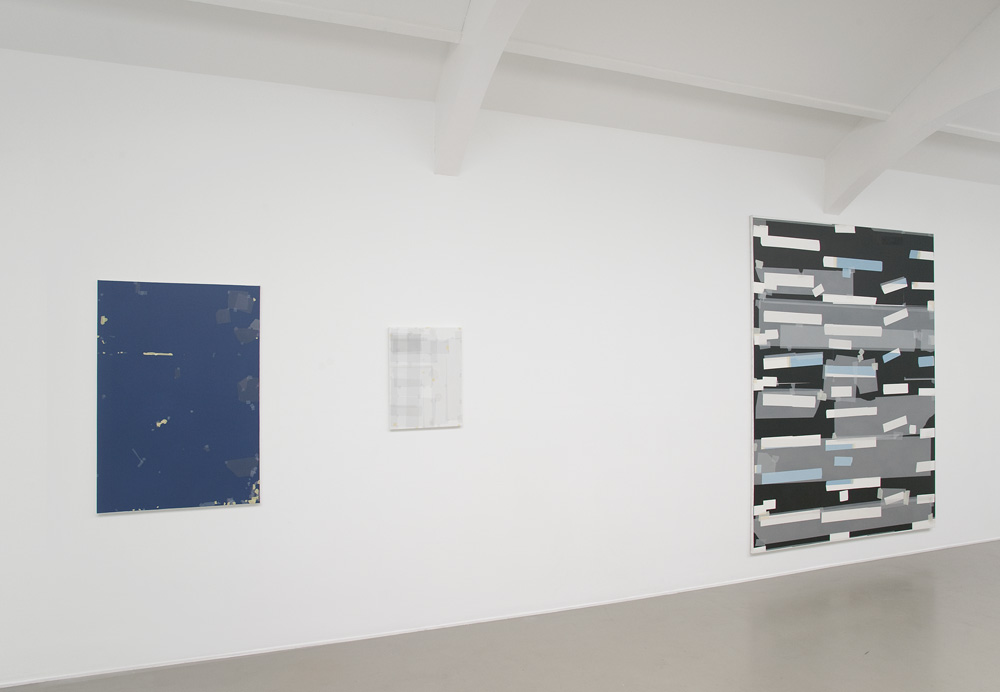
De Kabinetten van De Vleeshal, Middelburg 2014