DIETER ROELSTRAETE
[Mexico City, die Symphonie einer Grossstadt]
Pathways to the work of Kees Goudzwaard
This text was first published in Frontal Views,
Roma Publications, Amsterdam 2004.
Just as painting is a way of speaking about reality which can, if so desired, find its way towards
elucidation and/or poeticisation by the most varied and divergent pathways, there are very
different ways of speaking about painting. (Art history as a whole largely coincides with the
history of this 'speaking', of the various 'readings' that are used by the 'speakers'.)
Painting - the process, the result and of course the actual painter-as-artist - 'speaks' to us and
appeals to us (which is, incidentally, something quite different from 'communicating') in a
Babel-like confusion of accents and tongues, in tones that are both literally and figuratively high
and low, at times clear and at times barely comprehensible, at times archaic and at times as though
it were thieves' cant from the future, slow and staccato or plunging headlong. What we, the public,
'hear' in painting, what we detect or perceive in the language of paintings, literally accept as
'true', is the subject matter of the language of art history - and it is precisely this speaking
about painting that I want to discuss (among other things!) in this brief reflection on the work of
Kees Goudzwaard.
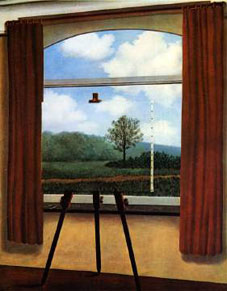
We speak of painting, of paintings, as a 'window on the world' - a persistent old idea that has
given rise to what could be termed 'the realist enterprise' (not to be confused with
nineteenth-century realism as a distinct idiom or tradition!). The world impinges on us as reality
through the framework of the painter's canvas, on which it leaves an imprint or 'impression'. We
look at the world as reality through that framework: we assume that what is painted corresponds
realistically to the reality that is represented, and we 'believe' in the unambiguous nature of
that representation. The painting avoids interpreting, let alone changing, reality - instead, it
simply records it, granting us a glimpse of the world when it is not (or is no longer) there. The
idiom and the notion of paintings as a 'window on the world' reached their culmination in the
famous canvas by the Belgian surrealist René Magritte, significantly entitled The Human Condition I
(1933): an astute summary of the graphic achievements and conceptual limitations of a philosophy
that seeks to look at the world through paintings - through the medium of paintings.
Beyond this extrapolation of abstraction and figuration, which has ultimately proved quite sterile,
we speak of paintings as a completely self-contained, autonomously linguistic universe: an
experimental space in which one can 'play' with other forms of conceptualisation and symbolisation
and seek ways of speaking about reality beyond the visually unambiguous language ('realism') of
reality itself. The painting as plan, map, chart, diagram, symbolic order, discourse, allegory - a
term which is, incidentally, derived from the Greek 'allo agoreuein', meaning 'to say/mean
something else': 'to mean something other than the pure thing itself' ('realism' once more) - is
more or less how Martin Heidegger defines the essence of art in his pioneering essay on the origin
of works of art (apart from this 'saying something else', Heidegger also mentions the etymology of
the concept of the symbol, from the Greek 'sum-ballein', 'bringing together the One and the Other'
- an essential key to a fuller understanding of art).
We read paintings as plans, diagrams, charts or symbolic manifestations, and speak of painting as a
set of diagrams, as a tradition of symbolic use of language, as an atlas or encyclopaedia that is
supposed to solve for us the mystery of visual experience: cartography, schematisation and
symbolisation (which together are all 'abstraction') have been the pillars of painting's hegemony
ever since it was manoeuvred out of its monopoly on the portrayal of reality ('reproduction') by
the democratisation and popularisation of photographic technology in what Walter Benjamin terms
'the age of mechanical reproduction'. Malevich, Kandinsky, Miró, Lissitzky and De Chirico in
pre-war Europe, Pollock, Kline, Newman, Rothko, Still, Reinhardt, Louis, Noland and Kelly in
post-war America: in casting off the traditional dictates of representation, these artists have
left viewers somewhat in the lurch, forcing them to work out for themselves what painting is
talking about in these 'post-realist' times, to fill up the abstraction-shrouded silence of
painting with a language of their own. It is here that the freedom - so peculiar to art - of the
many different ways of speaking about painting emerges.
The now celebrated allegory by the New York art critic Rosalind Krauss - one of those many
different ways of speaking about painting - centres on the mythical figure of 'the grid'. Krauss
calls the grid one of the creation myths of modernism and its ingrained avant-garde thinking: the
grid codifies the silence of the avant-garde artist as a refusal to speak. 'The absolute stasis of
the grid, its lack of hierarchy, of centre, of inflection, emphasises not only its anti-referential
character, but - more importantly - its hostility to narrative. This structure, impervious both to
time and to incident, will not permit the projection of language into the domain of the visual, and
the result is silence.' The flexible, primal form of the grid - so suitable for endless repetition
('reproduction') and paraphrase - is the primordial condition for countless works by artists with a
primarily schematic, abstractifying slant: Carl Andre, Sol LeWitt, Eva Hesse, Robert Ryman, Agnes
Martin, Robert Mangold, Jasper Johns. (Artists who, in Johns' wake, have concerned themselves with
the problems of the flag, are all consciously or unconsciously using the language of the grid.) The
fullest, most original - and hence most irreducible - expression of this philosophy of the grid is
to be found in the work of Piet Mondriaan, with which Kees Goudzwaard's work displays undoubted
parallels, if only in their shared predilection for patterns of horizontals and verticals, which
could be attributed to the typical Dutch talent for pure - indeed 'puritan' - thinking. The
two-dimensional space of the grid is a dehierarchised, decentralised ('rhizomatic') space: I always
feel somewhat disoriented when standing in front of Kees Goudzwaard's canvases, be they small or
large, long or wide. I 'read' from left to right or from bottom to top, but I search their panorama
of completeness in vain for a centre, a hub, a pivot, a focus. Instead of reading them in a linear
way, I view them in a circular motion. If this were a map of a place - why not an entire city? - I
would surely have got lost by now.
A second element in Krauss's description of the grid - namely that the result of every new
articulation of its primal form would be silence - strikes what is both literally and figuratively
an even more sensitive chord. For reasons that may say infinitely more about 'the eye of the
beholder' and the propensities and impulses of the individual viewer (i.e. myself), Kees
Goudzwaard's work strikes me as almost musical - or perhaps I should say musicological, musically
'organised'. His paintings seem like musical scores.
In the 1950s and 1960s, new kinds of music necessitated the development of new systems of notation:
the adventure of new music - from Anton Webern, Olivier Messiaen or John Cage onwards - is likewise
the adventure of a new visual imagination, and in the multidisciplinary spirit of a modernistic
musical Bauhaus many composers of this 'new' music not infrequently proved to be visual and graphic
innovators. The scores of Luciano Berio (Sequenza III), Cornelius Cardew (The Great Learning),
Morton Feldman (Projection II), György Ligeti (Volumina), Steve Reich (Four Organs, Music for
Eighteen Musicians), Karlheinz Stockhausen (Hymns, Contacts, Crossplay, Procession) and Earle Brown
reveal the intrinsic musical revolutions initiated by their respective authors; they are all
monolithic abstracts, all equally heavy and dense, with an unmistakably graphic quality that
suggests and insinuates the sound rather than dictates it. The spartan scores written by Feldman,
paradoxically a fellow traveller of the abstract expressionists, evoke the extremely hushed, lean
universe of Agnes Martin's minimal canvases: carpets of sound without incident or direction, in
which we are always 'already' present, without beginning or end, without origin or destination - in
short, the grid. Rather as in the popular cliché of modern abstract painting - the stereotyped
caricature of the Picasso that is hung the wrong way up - the score of Stockhausen's Cycle can 'be
read in any direction' (from left to right to left, from bottom to top to bottom - why not even
diagonally?). The score of John Cage's Fontana Mix leaves more or less everything to the
imagination of the player as a 'reader' or viewer; once again we are dropped into a seemingly
random undergrowth of idiosyncratic stripes, lines, smudges, dots and blobs, as though it were an
'abstract' environment - a Joan Miró or Cy Twombly blown up into three dimensions, as it were.
Ligeti's scores can best be compared to a Kandinsky or Johannes Itten's basic colour alphabet:
music as cosmic planning, and painting as the 'music of the spheres'.
Kees Goudzwaard's paintings, too, seem like 'writing methods' or scores - attempts to achieve a new
plastic idiom, to find new ways of understanding, grasping and bringing order to the chaotic
rhizome of visual experience, using the traditional parameters of line, field, plane and colour:
the grid as 'method'. Maps and plots, the generic façades of characterless apartment buildings,
page layouts, the playing surface of a card table, the 'random' pattern of falling pine needles - a
floral variation on Marcel Duchamp's Erratum Musical? - or a chequerboard of Post-its, letterheads
and memos: in all these schematic arrangements, the building blocks and basic structures of
Goudzwaard's meticulously composed trompe-l'oeils, one can hear the echo of a primordial grid; tone
takes precedence. (Colour is of primordial importance even in Kees Goudzwaard's strictly
disciplined, seemingly colourless universe: the sensual patches of colour, the well-balanced
colouring and the tactile presence of delicate layers of masking tape radically distinguish this
work from purely conceptual, 'cerebral' painting - tone and colouring are what give it its
unmistakable physique.)
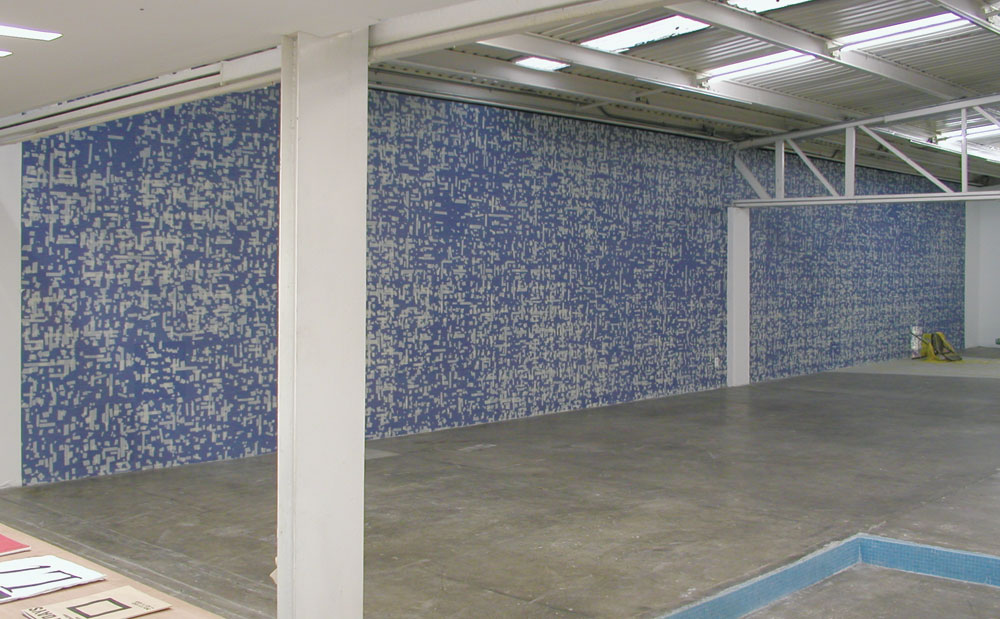
Music and metaphor. The large 'mural' that Kees Goudzwaard created in spring 2003 at the Programa
Art Center in Mexico City - home to the great Mexican tradition of muralists such as Orozco, Rivera
and Siqueiros - summons up an impressive array of complementary 'readings' and conceptualisations:
if this painting is truly speaking to us, it is 'speaking in tongues' to each of us. Goudzwaard
himself calls it a 'panorama' (not the first time that this evocative word has been used as a
title) designed to express the city's extreme diversity - but how? Like a satellite photograph that
records the carefully orchestrated grid pattern of streets, side streets and intersections? Like a
snapshot (note the characteristic studied nonchalance) from the urban jungle, with its dense,
rampant undergrowth of signposts, signals, traffic signs and garish neon lights? Like the cars in
Jacques Tati's Playtime, that ambiguous panegyric to the post-war welfare state and modern traffic?
Or perhaps like an energy or force field that is constantly under high tension (Mexico City is held
together by an impenetrable mass of electricity cables, transformer boxes and power stations
besieged by pirate networks - one vast, shimmering electromagnetic field that transmits shock waves
through the thin, dry air). Like the motherboard on my (or his) computer? The spiritual father of
cyberpunk, William Gibson, once compared Los Angeles' urban sprawl, as seen from the air at night,
to a computer chip (a virus would have been just as apt: The Matrix, Pac-Man). Like a school blackboard covered with
infinitely complex mathematical formulae that are meant to describe and predict the behaviour of
elementary particles in a wind tunnel or particle accelerator? Like a choreography - the line dance
of hooting taxis? Why, yes, a carpet of sound: in this monumental score, Kees Goudzwaard's work
again strikes me as well-nigh musical - I cannot help thinking of the jumpy montage and turbulent
changes of pace in Walter Ruttmann's Berlin: symphony of a great city, a classic 'documentary' city
portrait from the golden age of German cinema, in which the city comes to life as a character in
its own right. Did the scores written by Luigi Russolo and his fellow bruitists - as the futuristic
composers styled themselves - look anything like this? How else do you get factory smokestacks to
wail, and what better way to give the everyday chaos of traffic in this megalopolis of twenty
million people its own system of 'musical' notation, as in Morse code, the abacus, the braille
script of literally thousands of identical-looking pieces of ticker tape? Panorama (1994)
The grid: what Rosalind Krauss has called the proverbial 'global positioning system' of modern art
- and the role or function of this grid is none other than to produce meaning as 'positioning', to
create system and order in the potentially boundless primal soup of abstraction - is also, of
course, what the imagination of the modern city has created. The chequerboard pattern of Barcelona,
New York - the best city portrait ever painted is still undoubtedly Piet Mondriaan's Broadway
Boogie Woogie - and downtown Mexico City, the concentric circles and spokes of Moscow and Vienna:
urban traffic scores turned into streets and bricks, horizontal and vertical symphonies of steel,
glass and concrete. The primary basic language of the grid is a script of grand movements,
schematic gestures, abstraction: the grid produces the space in which to live (in urban terms) and
the space in which to see and visually experience the symphonies of form, colour and division into
fields (in painting terms). The grid produces the playing field as a sphere of activity. Perhaps
paradoxically, the rigid structural logic of Goudzwaard's grid Panorama - the basis consists of
four different photograms of ticker-tape compositions glued to a plain blue-grey background -
produces freedom: the notion that there is a 'chaos theory' underlying the cosmic order of being,
the uncontrollable contingencies and entropies of contemporary 'urbanness', the freedom of the
'performer' (of the painting, of life in that particular city) to read and interpret as he sees
fit, the freedom of the artist to act, describe and define, and, out of the millions of different
permutations of the image, to select this particular one. Finally, Panorama also produces the
freedom of the viewer and listener (such as me) to get lost, if so desired, in its inextricable,
bottomless labyrinth of sign and meaning - as if in an outsize city brimming with promise, or in
the building with infinitely many rooms that is, after all, art.
PS.
An afterword on seeing the first printer's proofs. My 'favourite' painting - if the writer of
this article can be allowed to slip such subjective ('my') nuances and considerations into the line
of his thought - turns out to have been included in the book: Leporello (2000)! And it has been included
in a very unusual way, triggering off even more lines and circles of thought.
Plans, patterns, grids, diagrams, graphs, road maps, atlases, musical scores in time and space -
geography, street plans: all these entail reduction, minimalism, abstraction, economy and
simplification, and inevitably also detract from the - by definition irreducible - reality of the
experience known in ancient Greek as 'aisthesis'. Plans, maps, diagrams, grids - the symbolic order
- may make the world clearer, more transparent, but they are still travesties of the reality they
are supposed to represent. This paradox tightens the Gordian knot of the age-old theological
dispute between figuration as a paltry attempt at portrayal and abstraction as an idealistic
caricature.
So is there really no kind of geography that resists this reductionistic, seedy, levelling logic?
Certainly: the mythical map of Borges' wonderland, which in its manic pursuit of perfection
'imitates' reality so meticulously, conscientiously and faithfully that it becomes that reality,
thereby devouring and obscuring it - a Map of the world, scale 1:1, which in its urge to transcend
the shortcomings of abstraction, reduction and schematisation completely covers the world it has
mapped, and so coincides with it. What has become of the world that the map refers to? Does such a
portrayal of the world, which is meant to be as complete as possible, include the portrayal itself?
And so on. No wonder Borges' literary allegory has kept generations of logicians so busy... In the
building with infinitely many rooms that is Kees Goudzwaard's art, I find myself in the Leporello
palace of mirrors, life-size: where is the emergency exit to reality?
Programa Art Center, Mexico City 2003